

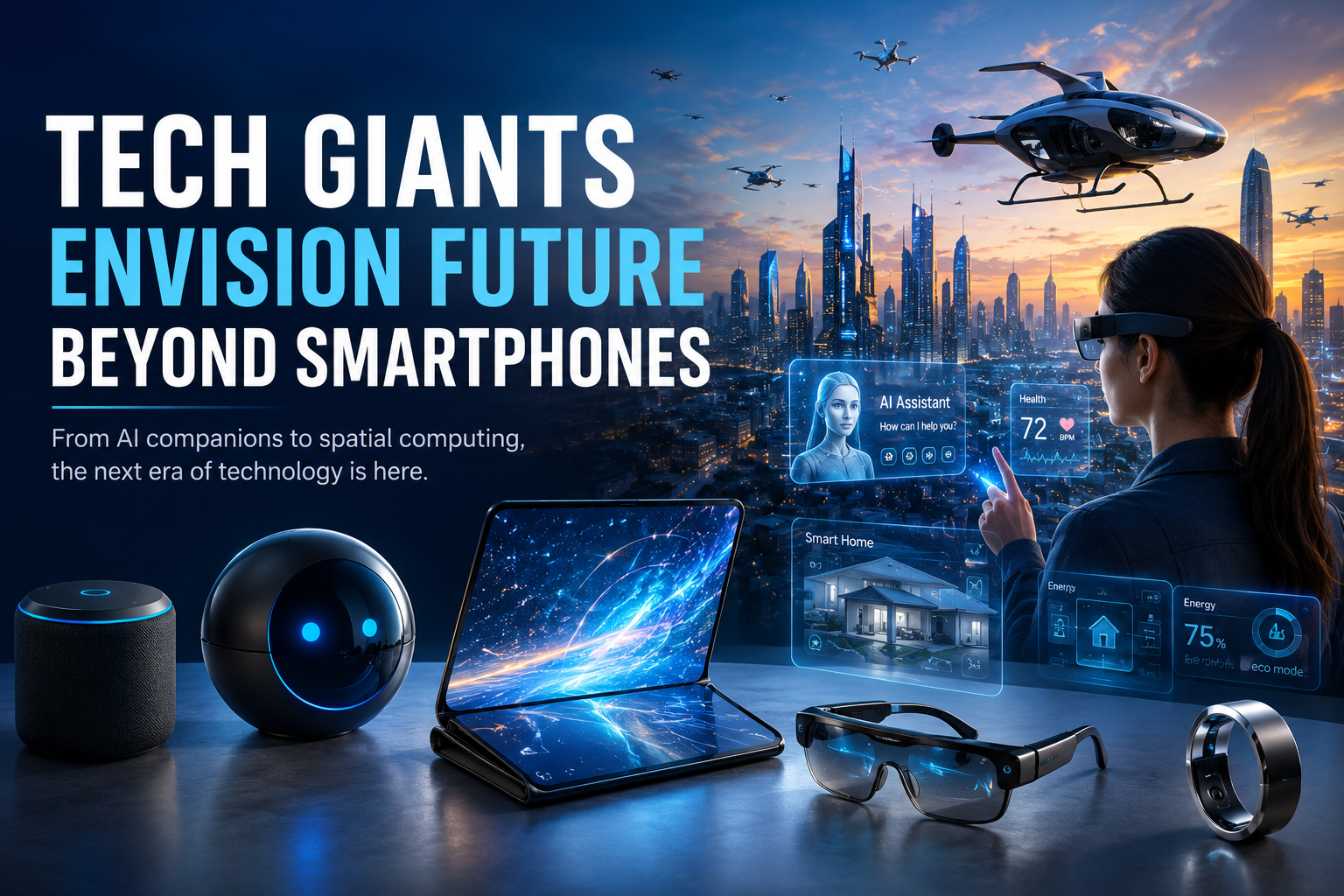
Explore tech giants envision future beyond smartphones and how Apple, Meta, Google, and OpenAI are investing billions to replace smartphones with AR glasses, AI wearables, ambient computing, and brain-computer interfaces.
Introduction: Tech Giants Envision Future Beyond Smartphones
For nearly two decades, the glowing glass rectangle in your pocket has served as the unquestioned epicenter of human digital existence. Smartphones revolutionized how we communicate, navigate, shop, and work. However, the tech landscape in the United States is undergoing a quiet, monumental pivot.
Smartphone innovation has reached a plateau of incremental upgrades—a slightly brighter screen, a marginally faster chip, or a higher-megapixel camera. At the same time, consumers across the U.S. are experiencing profound screen fatigue and attention fragmentation.
Tech giants like Apple, Meta, Google, and OpenAI are actively investing billions into technologies that move beyond smartphones—focusing on AR glasses, AI wearables, ambient computing, and brain-computer interfaces. This shift is driven by smartphone market saturation, screen fatigue, and the demand for hands-free, immersive digital experiences.
Understanding this evolution isn’t just about previewing gadgetry; it is about recognizing how the human relationship with information, work, and social connection will be rewritten over the next decade.
The Catalyst: Smartphone Saturation & Screen Fatigue
The drive toward a post-smartphone world is fueled by a combination of consumer behavior and hardware economics:
- Hardware Saturation: Smartphone replacement cycles in North America have stretched to record lengths. Most consumers keep their devices for 3 to 4 years because new models offer diminishing functional returns.
- Cognitive Load & Screen Fatigue: Studies consistently highlight the psychological toll of constantly staring down at a handheld screen. The current paradigm forces humans to adapt to the device, pulling us out of physical reality.
- The Desire for Heads-Up Computing: The industry’s consensus goal is “heads-up, hands-free” interaction—bringing digital utility into our natural field of view without breaking real-world engagement.
Key Takeaway: The smartphone isn’t dying overnight, but it has hit its architectural ceiling. The next platform must merge digital intelligence into the physical environment seamlessly.
Mark Zuckerberg’s Vision: Replacing Phones with True AR Glasses
When asking what Mark Zuckerberg will replace smartphones with, the answer is clear: true augmented reality (AR) glasses backed by contextual multimodal AI.
Meta has invested tens of billions through Reality Labs to create a pair of everyday glasses that blend holographic displays with physical surroundings.
The Meta Orion Benchmark
Meta unveiled its Orion prototype—widely regarded as one of the most advanced pairs of true AR glasses ever created. Unlike heavy mixed-reality headsets, Orion looks like a classic pair of thick-rimmed glasses with transparent lenses.
Practical Example
- Smart Pantry Assistant: Wearing Orion, you open your refrigerator. Meta AI visually scans your ingredients, projects a holographic recipe directly onto your kitchen counter, and guides you step-by-step through cooking while keeping your hands completely free.
- Life-Size Holograms: Rather than holding up a phone for a FaceTime call, Meta’s AR roadmap aims to project life-size 3D avatars of colleagues or family members into your living room.
Apple’s Post-iPhone Ecosystem: From Vision Pro to Lightweight Frames
Apple is approaching the post-smartphone future through a multi-stage ecosystem strategy. While the Apple Vision Pro introduced spatial computing to power users, Apple recognizes that spatial computing must shrink into everyday eyewear for mass adoption.
+-------------------------------------------------------------------------+
|                    APPLE'S HARDWARE EVOLUTION ROADMAP                  |
+-------------------------------------------------------------------------+
|                                                                         |
|  [2024–2025]              [2026–2027]              [2028+]            |
|  Spatial Computing        Displayless Smart        True Lightweight   |
|  (Vision Pro Series) ---> Glasses Framework   ---> Holographic AR     |
|  High fidelity,           Audio/Camera/AI,         Waveguide Optics,  |
|  tethered immersion       lightweight everyday     stand-alone OS     |
|                                                                         |
+-------------------------------------------------------------------------+
Apple’s Dual-Track Hardware Strategy
- Lightweight Headsets: Refining the Vision line (such as the lighter Vision Air) for immersive productivity, entertainment, and remote work.
- Displayless Smart Glasses (Expected 2027): Smart frames similar to traditional eyewear featuring cameras, spatial audio, and Apple Intelligence environmental sensing—replacing airpods, phone cameras, and glanceable Siri tasks.
- Full Waveguide XR Glasses (Expected 2028+): Color waveguide displays embedded in stylish frames that project UI elements directly into your field of vision.
OpenAI & Jony Ive: The Era of Screenless “Calm” Computing
One of the most anticipated moves in hardware is the partnership between Sam Altman (OpenAI) and legendary former Apple design chief Jony Ive.
Following OpenAI’s acquisition of Ive’s startup io, the team is developing a radically different consumer hardware platform.
The Vision: “Calm Computing”
Rather than adding another screen to your life, OpenAI and Jony Ive are building screenless, voice-first AI hardware.
- The Concept: A device that listens, observes, and understands context without demanding your visual attention.
- Form Factors: Prototypes under development explore unobtrusive wearables—such as earwear or subtle magnetic pins—focused on fluid, conversational interaction.
- Philosophy: Moving away from addictive app grids and notification badges toward an assistant that quietly manages your digital life in the background.
Google’s Ambient AI Strategy: Gemini & Project Astra
Google’s vision for replacing the smartphone rests on ambient computing—the idea that technology should be everywhere around you, available when needed, but invisible when not.
Multimodal Vision with Project Astra
Google’s Project Astra serves as the intelligence backbone for future hardware form factors. Astra transforms the Gemini AI model into a universal real-time assistant that can see and understand the physical world through audio and video streams.
Practical Example
- Instant Problem Solving: Walking through a city wearing Gemini-enabled smart frames, you look at a complex mechanical engine or a foreign sign. You ask, “What is this part and why is it making a clicking sound?” Astra analyzes the video feed instantly and provides voice-guided troubleshooting.
AI Wearables & Screenless Form Factors
Before full augmented reality glasses become lightweight and cheap enough for universal adoption, intermediate AI wearables are bridging the gap:
| Wearable Category | Primary Capabilities | Target Smartphone Function Replaced |
| Smart Frames / Glasses | Audio playback, camera capture, multimodal visual search | Notifications, camera, music controls, search bar |
| AI Pins & Clips | Voice interaction, laser projection, personal logging | Quick messaging, voice memos, digital assistants |
| Smart Rings & Biosensors | Continuous biometric tracking, micro-gestures | Health tracking, biometric authentication, input control |
| Contextual Hearables (In-Ear) | Real-time voice translation, whisper assistants | Call handling, navigation prompts, screen reading |
Brain-Computer Interfaces (BCIs): The Ultimate Frontier
Looking 15 to 20 years into the future, the physical input barrier (touchscreens, keyboards, and voice commands) will eventually yield to direct neural interfaces.
Beyond Touch and Speech
Led by companies like Neuralink, Synchron, and Precision Neuroscience, Brain-Computer Interfaces (BCIs) read neural signals directly from the brain.
- Immediate Impact: Restoring mobility and speech control for individuals with paralysis or neurodegenerative conditions.
- Long-Term Consumer Future: Eliminating physical hardware altogether. Intent-driven control allows users to send texts, navigate AR menus, or interact with AI at the speed of thought, bypassing muscle movement or spoken words.
What Is the Next Big Phone Coming Out & What Will Be the Future of Smartphones?
While tech giants invest heavily in a post-smartphone future, smartphones will remain the dominant digital anchor for the immediate short term. This raises two critical questions for consumers today:
What Is the Next Big Phone Coming Out?
In the near term, smartphone evolution is centered on foldable architectures, on-device generative AI, and silicon efficiency:
- Next-Gen Tri-Fold & Ultra-Thin Foldables: Pushing tablet-sized screen real estate into pocketable form factors.
- On-Device Agentic AI: Smartphones transitioning from app launchers into autonomous AI agents that perform multi-step tasks across banking, ride-hailing, and booking without requiring app navigation.
What Will Be the Future of Smartphones?
Over the next 5 to 10 years, the smartphone will undergo a fundamental identity shift:
[Standalone Slabs] ---> [Compute Hub / Tether] ---> [Cloud Ambient Node]
  (Current State)          (Mid-Term Horizon)            (Long-Term Horizon)
- Phase 1 (Current): Standalone pocket computers hosting all display, input, and processing functions.
- Phase 2 (2026–2030): The phone acts as a pocket compute hub—a silent engine streaming power and network connectivity to your AR glasses, smart watch, or earwear.
- Phase 3 (2030+): The phone disappears entirely, its compute distributed across ambient cloud AI and lightweight wearable sensors.
Technological Barriers: Battery, Optics, Heat, and Privacy
Replacing a device as refined as the modern smartphone requires solving massive engineering and social challenges:
Technical Bottlenecks
- Optical Efficiency: True AR requires ultra-bright displays (waveguides) that remain readable in direct sunlight without consuming excessive power.
- Thermal & Battery Limits: Packing high-performance AI chips, wireless radios, and batteries into lightweight frame temples under 70 grams without overheating is extremely difficult.
- Latency: Real-time spatial tracking demands sub-millisecond motion-to-photon latency to prevent motion sickness.
Social & Privacy Challenges
- Always-On Cameras: Widespread adoption of smart glasses raises major legal and ethical questions around recording in public spaces without explicit consent.
- Data Security: Devices that record continuous visual and auditory context capture massive amounts of personal data, demanding decentralized, on-device encryption.
Economic & Societal Impact on the U.S. Consumer
The shift away from pocket screens will restructure daily life across the United States:
Workplace Productivity Shift
With AR glasses and ambient AI, knowledge workers will no longer be chained to dual-monitor desk setups. Virtual workspaces will allow unlimited floating windows anywhere—from an airport terminal to a home office.
Restoring Presence & Digital Wellness
By removing the physical barrier of staring down at a screen, heads-up computing aims to restore natural eye contact and real-world social presence. Instead of pulling out a phone to check an email during dinner, context-aware AI can filter and surface only urgent alerts through brief audio or subtle visual cues.
Conclusion: The Horizon Beyond the Screen
The answer to “What will be the next big thing after smartphones?” is not a single device, but an ecosystem. It is an era defined by ambient intelligence—where computing shifts from something you carry and look at, to an invisible layer that wraps around your physical environment.
Over the next few years, smartphones will remain our primary digital lifeline, evolving into AI-driven compute hubs. But as Meta scales its AR glasses, Apple refines spatial eyewear, OpenAI redefines calm screenless hardware, and Google weaves Gemini into ambient environments, the screen in your pocket will slowly give way to the world in front of your eyes.

3 Comments
Pingback: Latest Tech Info At Beaconsoft OS 4.2, AI Automation - techbizfeeds.com
Pingback: Best Wireless Earbuds Under 200 Dollars 2024 - techbizfeeds.com
Pingback: Do The Driving Modes In Cadillac Lyriq Offer Different Ranges or Battery Usages? latest guide 2026 - techbizfeeds.com